
Caped Topographies 1
Introduction I: Mapping the Visual

In this series, Caped Topographies, I will be examining the largely, though not entirely, urban topographies and cartographies of the big two capes comics publishers(DC and Marvel Comics). In my other ongoing comic book essay series, “Towards a Postpunk Superheroics,” which examines Vertigo Comics through a post-punk lens, I’ve discussed the distinctions between the mythic structure of DC Comics’ narratives and the folkloric structure of Marvel comics. DC’s characters are deific, platonic ideals of heroes boiled down to inexorable heroic essence, whereas Marvel’s characters are gods pulled down to earth, or humans elevated to the liminal space of the demigod. In Caped Topographies I will examine this framework via the skyline of Marvel and DC’s environmental settings, and reveal how Gotham, Metropolis, and Central City exist in relation to the New York and Los Angeles of Marvel’s universe.
Comics is a form especially suited to the centering of both cartography and topography. The comic itself, its panels and gutters resemble a simplistic rendering of a city’s streets and blocks when looked at from above, but that the comic page also exists in a vertical world, in which characters fall from the top of the page to the bottom, and fly from bottom to top. Whereas prose exists in a world largely devoid of visual cartography, with the mapping of a novel’s space existing largely in the imagination of the reader themself, and a film’s cartography exists in the imperceptible flickering from one frame to another, the map of a comic is part and parcel to the form itself.
The comics cartography extends beyond simple space. It simultaneously maps space but also time, in the form of action shown within the panel, and chronological progression implied in the gutters. Time is present in geographic maps as well: you can look at a map of a city or a country and gauge, from the distance and complexity of a route from point A to point B, how long a trip might take you. A map implies action, movement through the space depicted or, at the very least, existence within it. The comics cartography and the geographic cartography, like almost all tools are malleable depending on a user’s familiarity with them. My ability to predict travel time through my home city at a given time is much more precise than my ability to predict travel time in Paris. Similarly, someone who has never read comics’ ability to predict the reading time of a Chris Claremont X-Men Omnibus versus a Todd Macfarlane Spider-Man Omnibus of similar length are incredibly different.
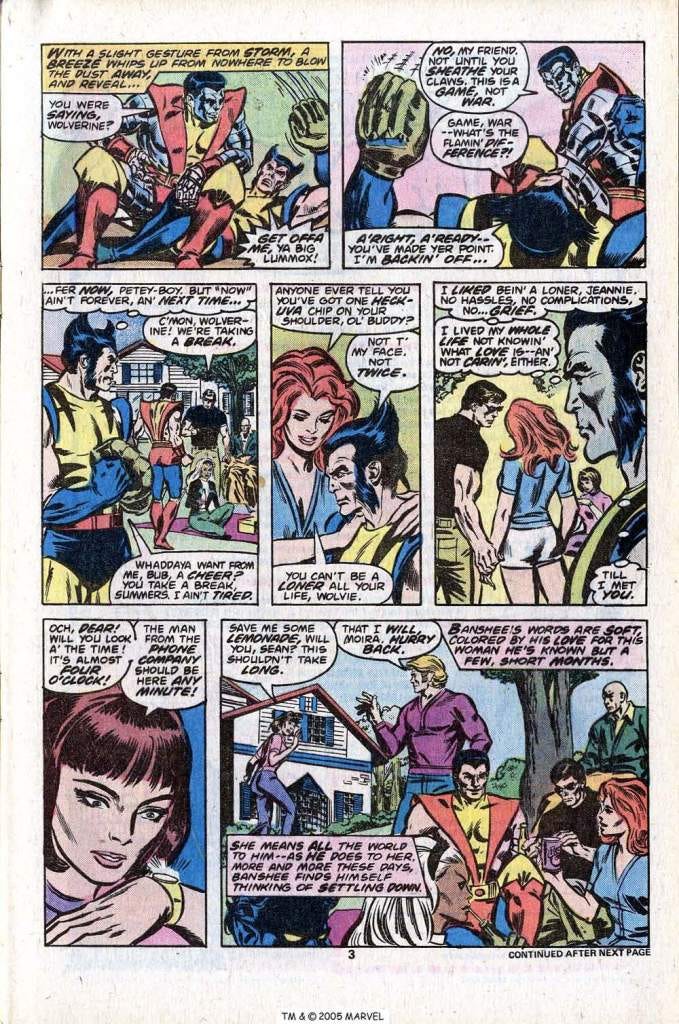
A page from a Claremont-written X-Men(Marvel) issue(and not even one of the wordier ones).
Beyond the simple metric of “reading time,” general formal familiarity with comics allows a reader to better understand the chronological metric of diegetic time within a comic based on layout(the basic comic-cartographic form), as well as the geographical metric of reading order. A reader with little familiarity with comics will have an easier time digesting a four panel gag strip like Calvin and Hobbes than a more formally complex work like Matt Fraction and David Aja’s Hawkeye, or Alan Moore’s Saga of the Swamp Thing.
![Excerpt] One of my favourite parts about Matt Fraction and David Aja's Hawkeye run is how they use paneling to turn the very act of shooting a bow into an art form (](https://substackcdn.com/image/fetch/$s_!0cTs!,f_auto,q_auto:good,fl_progressive:steep/https%3A%2F%2Fsubstack-post-media.s3.amazonaws.com%2Fpublic%2Fimages%2Fb1c49fff-aa1c-478e-b9b0-2fce9a7ece1e_640x687.png "Excerpt] One of my favourite parts about Matt Fraction and David Aja's Hawkeye run is how they use paneling to turn the very act of shooting a bow into an art form (")
A wonderful example of the experimental cartographies of Fraction and Aja’s Hawkeye(Marvel, 2012).
Marvel and DC both utilize these visual cartographical conventions in their respective house styles distinctly to reinforce the tonal differences between the two houses. The Hawkeye page above, published by Marvel in the early to mid twenty-tens reveals a fundamentally humanist, individualistic approach to the comics page, engaged with breaking down human movements to a molecular level in order to reveal the emotional subjectivity present in its characters. Contrast this with the contemporaneous page from Scott Snyder’s New 52 run of Batman, in which Batman is trapped in a maze by the Court of Owls.
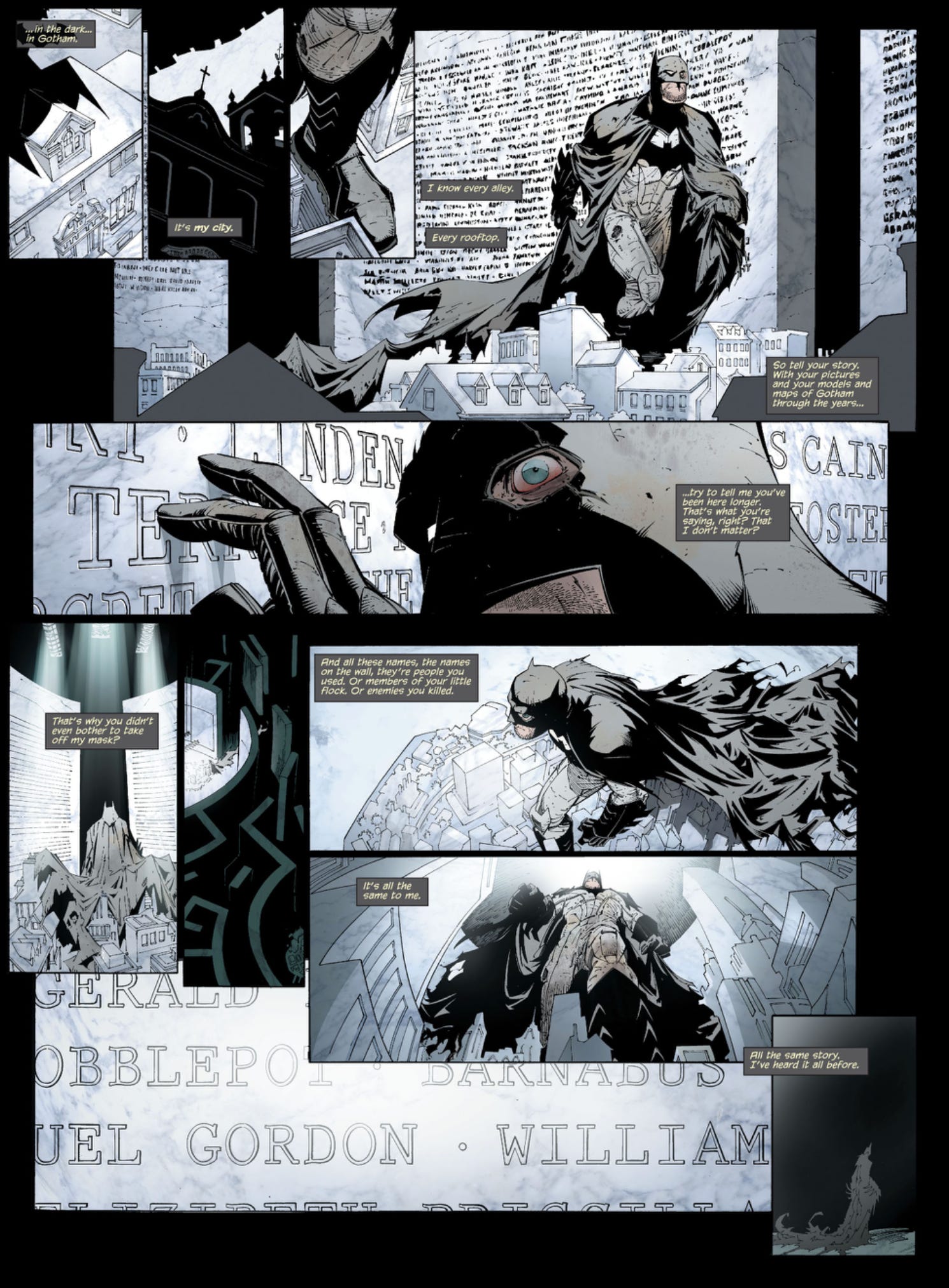
Snyder and Capullo’s Batman(DC, 2011) from the New 52 is trapped in a maze by the Court of Owls.
In Capullo’s cartography and topography on Batman, the eye wanders the page, chronologically and spatially confused by the layout in front of it(Cartography). Batman himself is morphed and devolved by the fisheye lens with which he seems to be drawn(Topography), and exists larger than the city around him. Batman’s character design too, shrouds and obfuscates his humanity even more.
Likely the most famous and recognizable image of Batman is from Frank Miller and Klaus Janson’s Batman: The Dark Knight Returns #1, in which batman is reduced to pure black outline, a symbol as immediately familiar as the outline of Mickey Mouse.
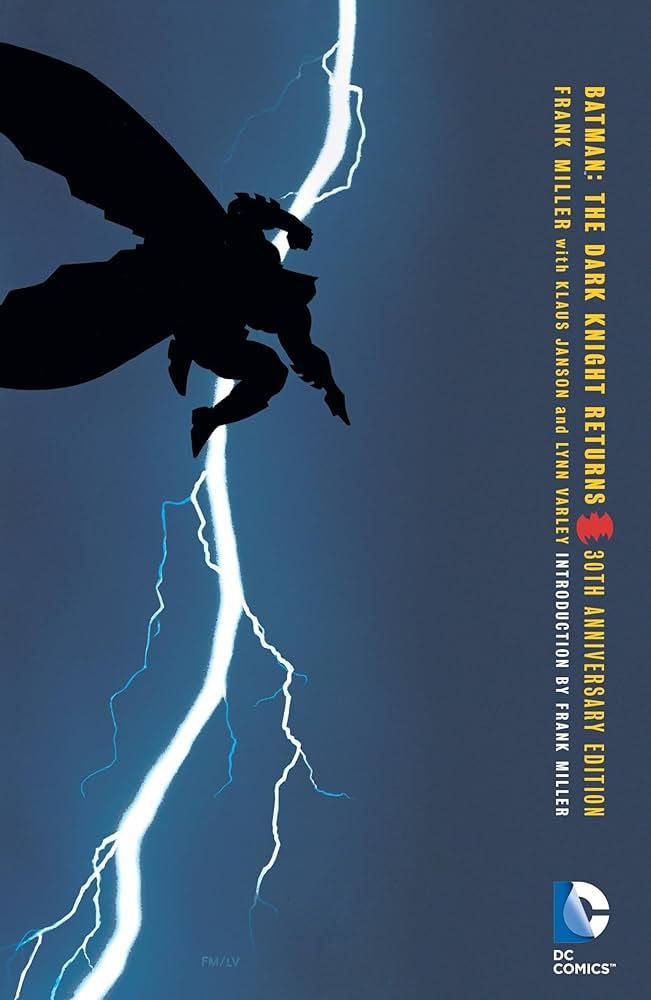
The cover of Batman: The Dark Knight Returns #1, reproduced for the story’s 30th Anniversary collection.
This aspect of cartooning reduces the character itself to topography. Batman here is no longer a subject but a sign. Compare this with the character design of such Marvel characters as Hawkeye, Spider-Man, or Iron Man, whose silhouettes amplify the act of costuming the hero rather than becoming the hero. Spider-Man is a man in latex, not immediately distinguishable from, say, Iron Fist or even a bald person. Herein lies he character topographical distinction between Marvel(human/folkloric) and DC(deific/mythic).
The next installment of this series, Introduction Part 2, I’ll talk about the ways in which cities are written in the big two, and how they demonstrate the distinction between the folkloric and the mythic. From there I will be writing about various runs of Marvel and DC comics which engage with the largely urban landscapes of their respective universes starting with Catwoman of East End by Ed Brubaker, Darwyn Cooke, Mike Allred, et al.